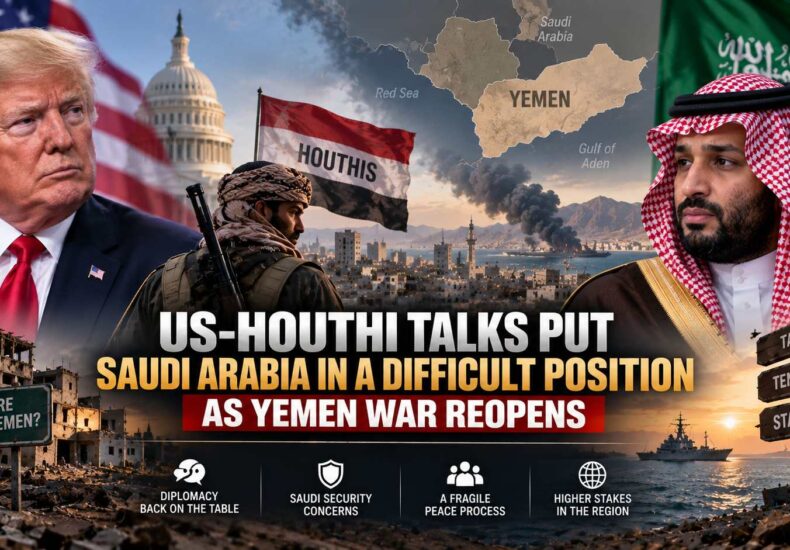
US-Houthi Talks Put Saudi Arabia in a Difficult Position as Yemen War Reopens
Saudi Arabia expected its most important ally to stand beside it as the Houthi movement surged across Yemen’s Red Sea coast.
Instead, Washington appears to be pursuing a different strategy.
U.S. officials have held previously undisclosed talks with representatives of Yemen’s Iran-aligned Houthis in Oman, according to people familiar with the meeting. The discussions reportedly focused on keeping American and international shipping out of the conflict, even as Saudi Arabia faces a rapidly intensifying Houthi offensive.
That does not amount to a formal U.S.-Houthi peace agreement.
But it does reveal a significant shift in priorities.
Washington appears to be trying to prevent the conflict from spreading to American forces and global shipping while leaving Riyadh to deal with the Houthi territorial advance and attacks on Saudi targets.
For Saudi Arabia, that creates a difficult strategic calculation.
Washington and the Houthis Talk While Saudi Arabia Fights
The meeting reportedly took place at the U.S. Embassy in Muscat, with Oman helping facilitate the contact. Reuters said five sources familiar with the discussions described the meeting.
According to the sources, Houthi representatives assured U.S. officials that they would maintain the 2025 ceasefire with Washington and would not target American vessels.
Some sources also said the Houthis indicated they would not attack Israeli or commercial shipping.
The details have not been publicly confirmed by the U.S. government or the Houthi leadership in a formal agreement.
That distinction is crucial.
Calling the meeting a “deal” risks making the arrangement sound much more formal and comprehensive than the available evidence supports.
What has been reported is better understood as a channel of communication and a possible limited understanding.
Saudi Arabia Wanted Direct U.S. Military Help
The timing makes the talks particularly significant.
Saudi Crown Prince Mohammed bin Salman had sought U.S. assistance as Houthi forces expanded their offensive in Yemen.
According to Reuters, Washington told Riyadh it was not prepared to take direct military action against the Houthis for the time being, although U.S. support could include intelligence sharing and targeting assistance.
That is very different from abandoning Saudi Arabia.
But it is also different from the kind of direct American military intervention Riyadh reportedly requested.
The distinction could become increasingly important if the Houthi advance continues.
The Houthis Have Changed the Map
The current crisis is not simply another round of missile attacks.
The Houthis have made substantial territorial gains along Yemen’s Red Sea coastline, pushing back forces aligned with the Saudi-backed Yemeni government.
Their advance has also brought them closer to strategically important areas around the Bab el-Mandeb Strait, one of the world’s key maritime chokepoints.
That gives the group more than battlefield momentum.
It gives it geography.
And geography can become leverage.
A movement positioned near a major international shipping route does not necessarily need to shut the waterway completely to influence global trade.
The possibility of attacks can be enough to raise insurance costs, change shipping routes and force governments to deploy additional naval protection.
Why Washington May Be Drawing a Line
The reported U.S.-Houthi contact suggests Washington may be trying to separate two issues.
The first is the protection of American forces and international maritime traffic.
The second is Saudi Arabia’s fight against the Houthis inside Yemen.
The United States may be willing to use diplomacy to prevent the first problem from becoming worse without committing its military to the second.
That would allow Washington to reduce the risk to U.S. ships while avoiding another large military campaign in Yemen at a time when American forces are already heavily involved in the wider Iran conflict.
The approach is not without risk.
It could leave Saudi Arabia questioning how far American security guarantees extend when Riyadh faces a direct regional threat.
Saudi Arabia Is Already Under Pressure
The Houthi offensive comes at an especially difficult moment for Saudi Arabia.
The kingdom is dealing with missile and drone threats while also facing disruption to regional energy infrastructure.
Reuters has reported repeated Houthi attacks on Saudi targets during the latest escalation. Saudi authorities have also issued security alerts covering areas including Mecca and Jeddah following attacks by Iran-aligned fighters.
Saudi Arabia has also reportedly sought additional air-defense support from other countries.
That suggests the problem is no longer limited to Yemen.
The conflict is increasingly affecting Saudi Arabia’s ability to protect its cities, military assets and energy infrastructure.
The Missile-Defense Problem Is Becoming Serious
There is another reason Riyadh may be looking for outside assistance.
Saudi Arabia depends heavily on sophisticated air-defense systems to intercept missiles and drones.
But the wider Middle East war has placed extraordinary demands on those systems.
Al Jazeera, citing Associated Press reporting, said Saudi Arabia had asked France, Pakistan, Egypt and Britain for air-defense support. One official said U.S. interceptor stocks had also been reduced by the broader war with Iran.
If accurate, that creates a difficult equation.
Saudi Arabia may have the money to purchase advanced weapons, but money cannot instantly create additional missile interceptors or trained crews.
Modern air defense is an industrial system.
It depends on manufacturing, supply chains, radar coverage, trained personnel and stockpiles.
The Houthis Also Have an Economic Strategy
For the Houthis, control or influence around the Red Sea is valuable even without a complete maritime blockade.
The group can use threats against shipping as leverage.
International vessels may decide to avoid the area.
Saudi-linked shipping may face additional risks.
Energy companies may have to reconsider export routes.
And governments may have to spend more money protecting commercial traffic.
That is how a relatively small armed movement can create consequences far beyond the territory it controls.
The Houthi campaign has demonstrated this before.
The difference now is that the group has gained additional territory and positions along the Red Sea coast.
Bab el-Mandeb Is the Bigger Prize
The Bab el-Mandeb Strait connects the Red Sea to the Gulf of Aden.
For ships traveling between Asia and Europe, it is an important gateway toward the Suez Canal.
Any sustained disruption can force vessels to take the much longer route around Africa.
That adds fuel costs, transit time and pressure on global shipping capacity.
The importance of the waterway has increased further because disruptions around the Strait of Hormuz have already affected regional energy flows.
Two vulnerable maritime corridors create a very different problem from one.
If Hormuz is difficult to use and Bab el-Mandeb becomes risky at the same time, shipping companies have fewer practical alternatives.
Saudi Oil Exports Add Another Layer
The Red Sea is particularly important to Saudi Arabia because the kingdom has infrastructure designed to move crude toward its western coast.
That allows some oil to bypass the Persian Gulf and Strait of Hormuz.
But a route that ends near a threatened Red Sea corridor is only as secure as its final link to the sea.
This is why the Houthi advance matters to global energy markets.
The issue is not simply whether Saudi Arabia has oil.
It is whether Saudi Arabia can move that oil safely and economically to international buyers.
The Iran Connection Makes Everything More Complicated
The Houthis are closely aligned with Iran and have received Iranian support, but they are not simply a military branch controlled directly by Tehran.
That distinction matters when interpreting the latest U.S.-Houthi talks.
If Washington can reach a limited understanding with the Houthis, it does not automatically mean the United States has reached an understanding with Iran.
Likewise, Houthi decisions do not necessarily represent direct instructions from Tehran.
But the wider relationship means developments in Yemen remain closely connected to the broader Iran conflict.
That is why Saudi Arabia is watching Washington’s choices so carefully.
This Is Not Yet a U.S.-Saudi Break
The phrase “leaves Saudi Arabia in quicksand” captures the political tension, but it should not be interpreted as proof that the U.S.-Saudi alliance has collapsed.
Washington continues to cooperate with Riyadh.
The United States has also reportedly continued intelligence and targeting support while declining direct military intervention.
The more accurate description is that the two countries may currently have different priorities.
Saudi Arabia wants to contain the Houthi military advance.
Washington appears focused on preventing the Yemen front from becoming another major U.S. military commitment and on keeping international shipping protected.
Those goals overlap—but they are not identical.
The Real Question Is What Happens Next
The most important question is whether the reported U.S.-Houthi contact produces a durable reduction in attacks on international shipping.
If it does, Washington could argue that diplomacy is achieving an important objective without opening another major military front.
But Saudi Arabia would still have to confront the Houthi territorial gains.
That is where the arrangement becomes complicated.
A Houthi movement that stops attacking American ships could still attack Saudi targets.
And Saudi Arabia may have limited interest in an arrangement that protects international shipping while leaving its own vessels and territory exposed.
Riyadh May Need a New Strategy
Saudi Arabia now faces several options.
It can intensify military operations in Yemen.
It can seek a negotiated arrangement with the Houthis.
It can build a broader regional air-defense and military coalition.
Or it can combine elements of all three.
None is simple.
A major military campaign risks widening the war.
Negotiations could require accepting Houthi territorial gains.
A regional coalition takes time to organize.
And relying entirely on external military support may leave Riyadh vulnerable whenever its partners have competing priorities.
The Bigger Shift Is in How Alliances Work
The most revealing part of this episode may therefore not be the secret meeting itself.
It is the possibility that Washington is beginning to distinguish between protecting American and international interests and fighting every battle faced by a regional partner.
That does not mean the U.S.-Saudi relationship is ending.
It means the relationship is being tested under unusually difficult circumstances.
For decades, Saudi security planning has depended heavily on American military power.
The current crisis is forcing Riyadh to consider what happens when Washington’s interests do not perfectly match its own.
A New Middle East Security Equation
The reported U.S.-Houthi talks could eventually prove useful if they prevent attacks on American and international shipping.
But they do not solve Saudi Arabia’s immediate security problem.
The Houthis remain a powerful armed movement.
They have gained strategically important territory.
Saudi Arabia is facing attacks on its territory and pressure on its energy infrastructure.
And the United States is trying to avoid adding another large military commitment to a regional war already involving Iran.
That leaves Riyadh in an uncomfortable position.
The central question is no longer simply whether America will defend Saudi Arabia.
It is which Saudi interests Washington is prepared to defend directly, which it will support indirectly, and which Riyadh may increasingly have to handle itself.
The answer could shape not only the next phase of the Yemen war but also the future security architecture of the Gulf and the Red Sea.
You may also like
Leave a Reply