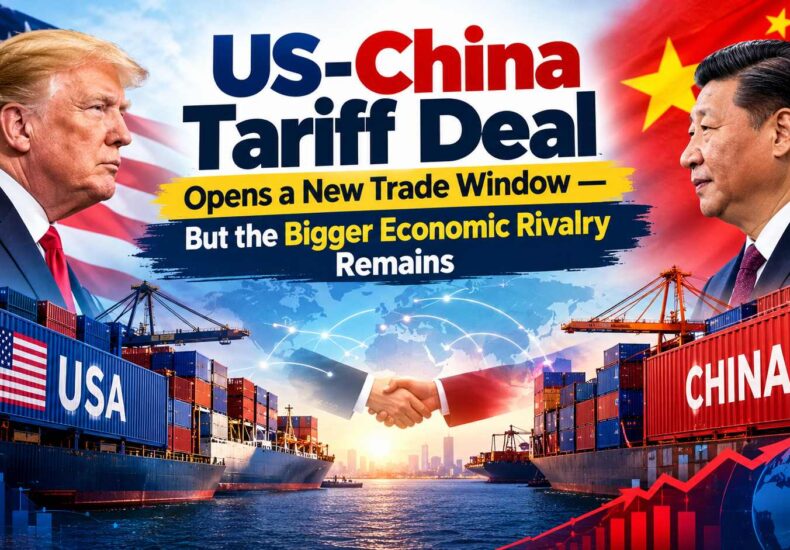
US-China Tariff Deal Opens a New Trade Window — But the Bigger Economic Rivalry Remains
The latest US-China trade agreement may look simple on paper: fewer tariffs on selected goods, better access for exporters and a new channel for economic discussions.
But beneath the list of farm products, toys and household goods is a much bigger story.
The United States and China are testing whether they can reduce some of the economic friction between the world’s two largest economies without giving up their broader strategic competition.
Following Chinese President Xi Jinping’s September visit to the United States, Washington and Beijing agreed to more favorable tariff treatment for $30 billion of non-sensitive goods in each direction. The arrangement covers products ranging from US agricultural goods and seafood to Chinese toys, small appliances and holiday decorations.
The agreement is significant, but it should not be mistaken for a comprehensive trade settlement.
Instead, it is better understood as a carefully limited opening in a much wider economic confrontation.
What the $30 Billion Deal Actually Means
The first thing to clarify is the headline number.
The agreement does not mean the United States and China are suddenly creating $30 billion in new trade.
Rather, the two governments agreed on more favorable tariff treatment for $30 billion worth of goods in each direction. That means the arrangement covers roughly $60 billion in bilateral trade when both sides are counted.
On the US side, Chinese products receiving more favorable treatment include small appliances, toys, holiday decorations and children’s car seats.
For American exporters, the list includes agricultural products, seafood, logs and wood products, cosmetics and medical devices.
That makes the deal unusually visible to ordinary consumers.
A toy on a US store shelf, a kitchen appliance, or a box of American agricultural products can all become part of the larger US-China tariff story.
Why Farm Goods Are Back at the Center
Agriculture has become one of the most politically and economically sensitive parts of the US-China trade relationship.
American farmers have long depended on China as an important export market for products such as agricultural commodities and meat.
At the same time, China wants reliable access to food and other essential imports without becoming excessively dependent on any single supplier.
The new tariff arrangement therefore serves both sides.
American exporters gain better conditions for selected products entering China, while Chinese exporters receive relief on certain consumer and household goods entering the United States.
It is a classic trade-off.
One side gets better access to consumers abroad, while the other gets lower costs for selected products at home.
And Then There Are the Toys
The inclusion of toys and holiday decorations may sound less important than agricultural commodities or medical equipment.
For American consumers, however, these products can be highly sensitive to import costs.
Tariffs are ultimately paid somewhere in the supply chain. Depending on market conditions, businesses can absorb part of the cost, suppliers can adjust prices, retailers can accept lower margins, or consumers can pay more.
That is why tariff reductions on consumer products can potentially ease some price pressure.
The White House said the arrangement could provide more favorable treatment for products including toys, small appliances and children’s car seats.
But consumers should not expect every product made in China to suddenly become cheaper.
The agreement covers specific categories rather than removing US tariffs across the entire Chinese import market.
The Trade War Has Not Disappeared
This is perhaps the most important point.
Washington and Beijing have not dismantled the broader tariff system that developed during years of economic confrontation.
Instead, they have carved out areas where both governments have an incentive to reduce pressure.
That distinction matters for businesses.
A company sourcing products from China cannot assume that every tariff has disappeared simply because the two governments reached this agreement.
The same is true for American companies selling products to China.
The tariff arrangement is targeted, and the details of implementation remain important.
A Trade Council Gives the Deal a Longer Life
Another important development is the creation of a bilateral mechanism for continued economic discussions.
The United States and China agreed to operationalize the US-China Board of Trade, providing officials with a channel for continuing negotiations rather than waiting for every disagreement to reach the presidential level.
That may prove more important over time than the initial tariff cuts.
Trade relationships generate thousands of individual disputes involving customs rules, market access, technology, agricultural purchases and supply chains.
Having a formal channel for discussing those problems can make it easier to prevent smaller disagreements from becoming larger confrontations.
It does not guarantee agreement.
But communication can make disagreement more manageable.
AI Is Now Part of the Trade Relationship
The US-China economic relationship is no longer just about soybeans, electronics and toys.
Artificial intelligence has become one of the central strategic issues between the two countries.
Washington and Beijing agreed to establish a new dialogue on AI, with discussions expected to cover both the benefits and risks of the technology. The two sides also agreed to establish a communication channel for AI-related incidents. Another round of discussions is expected by November.
This is significant because the two countries are simultaneously cooperating and competing in AI.
Both want advanced computing capabilities.
Both want leadership in the technology.
Both are concerned about the risks.
And both understand that AI is increasingly connected to national security, industrial competitiveness and economic power.
The new dialogue does not end that competition.
It creates a channel through which the competition can be managed.
Rare Earths Remain a Bigger Test
The tariff agreement also cannot be separated from the dispute over critical minerals and rare earths.
China has a major role in global rare-earth processing and supply chains, while the United States has been trying to reduce its dependence on Chinese-controlled sources.
The White House said the two countries would continue working on supply-chain concerns involving rare earths and other critical minerals.
This could become one of the most difficult parts of the relationship.
Toys and appliances are important to trade.
Rare earths are important to the industrial systems behind electric vehicles, electronics, advanced manufacturing and defense technologies.
That is why the next stage of US-China economic negotiations could be much harder than the current tariff arrangement suggests.
China Also Agreed to Buy More American Coal
The agreements reached during Xi’s visit extended beyond tariffs.
China agreed to purchase American coal, with the reported commitment covering 10 million metric tons in 2027 and another 10 million metric tons in 2028.
Energy trade adds another layer to the relationship.
The United States wants access to China’s enormous market for American energy products, while China wants reliable supplies from multiple sources.
This illustrates a broader reality about US-China relations.
Even when Washington and Beijing compete over technology and security, their economies remain interconnected in ways that are difficult to unwind quickly.
Businesses Get Breathing Room, Not Certainty
For companies, the immediate benefit of the agreement is predictability.
Businesses can plan more easily when they know that selected products will face lower tariffs.
But the wider environment remains uncertain.
The two governments have extended their existing trade truce by two months, giving negotiators additional time to work toward a broader arrangement.
That means companies still have to prepare for the possibility that negotiations could produce another agreement — or that disagreements could return once the temporary arrangements expire.
In global supply chains, uncertainty itself has a cost.
Companies may delay investment, seek alternative suppliers or hold additional inventory simply because they do not know what tariff rate will apply several months from now.
What This Means for American Consumers
The most immediate question for households is whether the agreement will lower prices.
It could help in some categories.
Lower tariffs on selected Chinese consumer products can reduce one component of import costs. Likewise, lower Chinese tariffs on American agricultural and other products can improve conditions for US exporters.
But tariffs are only one part of the final price of a product.
Shipping, labor, energy, exchange rates, raw materials and retailer margins also matter.
So the agreement may reduce some cost pressures without producing a dramatic across-the-board decline in prices.
What It Means for China
For Beijing, the arrangement provides better access for selected Chinese exports while keeping negotiations with Washington alive.
That matters at a time when China’s manufacturers are facing intense competition and companies are trying to maintain access to major overseas markets.
But China is also unlikely to abandon its broader strategy of building technological and industrial independence.
The tariff agreement therefore represents accommodation in selected areas, not a retreat from long-term economic competition.
The Bigger Message From Washington and Beijing
The most interesting aspect of this agreement may be the fact that the two governments have found areas where cooperation is possible without resolving their deeper disagreements.
They can lower tariffs on toys without settling semiconductor policy.
They can discuss AI without ending their technology competition.
They can expand agricultural trade while still arguing over industrial policy.
They can cooperate on selected energy purchases while competing over strategic supply chains.
That is the new shape of US-China economic relations.
It is less about choosing between cooperation and confrontation and more about doing both at the same time.
A New Phase of Managed Economic Competition
The $30 billion tariff arrangement is therefore best viewed as a trade window rather than a trade peace treaty.
It gives exporters some relief.
It may reduce costs for certain American consumers.
It creates a formal mechanism for further discussions.
And it shows that Washington and Beijing still have strong economic incentives to prevent their relationship from spiraling into unrestricted trade conflict.
But the difficult issues remain.
Technology restrictions, rare earths, AI leadership, supply-chain security and national-security concerns will continue to shape the relationship.
The latest agreement simply shows that the world’s two largest economies have found a way to lower the temperature without ending the competition.
For businesses, that is welcome news.
For policymakers, it is an opportunity.
But for the global economy, the real test will come later — when the temporary tariff relief meets the much harder question of whether Washington and Beijing can turn limited cooperation into a durable economic framework.
For now, the toys, farm goods and appliances have found a little more room to move.
The larger trade war, however, is still being negotiated.
You may also like

Leave a Reply