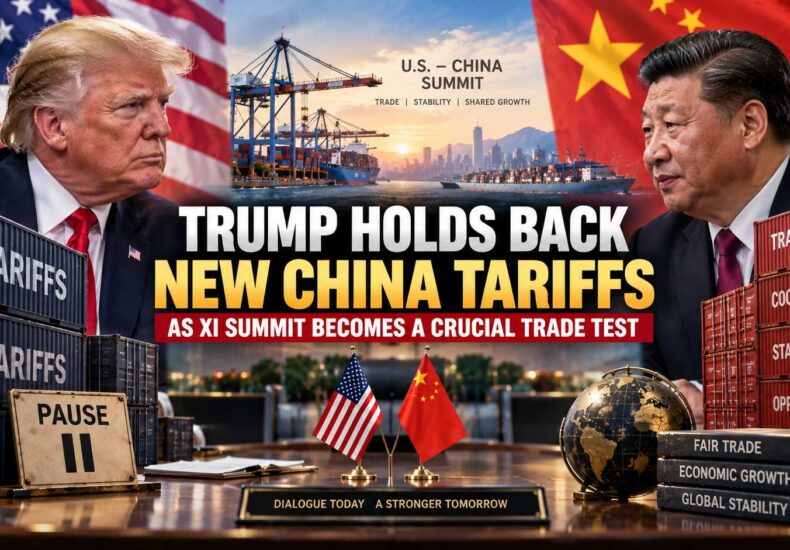
Trump Holds Back New China Tariffs as Xi Summit Becomes a Crucial Trade Test
The next U.S.-China trade battle may have been delayed—but it has not disappeared.
The Trump administration is expected to postpone announcing new tariffs targeting what Washington describes as excess manufacturing capacity until after President Donald Trump meets Chinese President Xi Jinping in Washington next week, according to people familiar with the matter. The reported delay comes just days before the leaders’ planned September 24 summit.
At first glance, delaying a tariff announcement might look like a softer approach toward Beijing.
But there is another way to read it.
The tariff threat is still hanging over the negotiations. By holding off on announcing the new duties, Washington may be preserving the threat as a bargaining tool while giving Trump and Xi an opportunity to reach an understanding before another trade measure is imposed.
That makes the upcoming summit about more than photographs and diplomatic statements.
It could determine whether the fragile U.S.-China trade truce survives its next major test.
The Tariff Has Not Been Cancelled
The most important distinction is simple: Washington has not abandoned the proposed tariffs.
The administration had been expected to release a report examining excess manufacturing capacity and recommending an additional 7.5% tariff on Chinese goods, according to earlier Bloomberg reporting cited by Moneycontrol. The latest reports indicate that the announcement may now come only after the Trump-Xi meeting.
Even the eventual tariff rate remains uncertain.
That means businesses and markets still do not know whether the planned measure will look exactly like the earlier proposal or be modified following the summit.
For companies dealing with Chinese imports, the uncertainty itself can be costly.
Why Is Washington Waiting?
The precise reason for the delay has not been publicly established.
But the timing is difficult to ignore.
Trump has repeatedly used the possibility of tariffs as leverage in negotiations with trading partners. Delaying the announcement preserves that leverage while avoiding an immediate escalation just before he sits down with Xi.
Think of it as leaving a negotiating card on the table rather than playing it before the meeting begins.
Washington can still impose the tariff later.
But if Beijing offers concessions during the summit, the administration could potentially adjust its approach.
That makes the delay significant even though it does not guarantee a deal.
What Is “Excess Capacity”?
The dispute goes beyond the simple question of how much China exports.
U.S. officials have raised concerns that China’s enormous industrial capacity in sectors such as manufacturing can produce more goods than domestic demand can absorb.
Those excess products can then enter global markets at competitive prices, putting pressure on producers in the United States and other countries.
Washington has increasingly argued that trade imbalances cannot be addressed only through tariffs on individual products.
Treasury Secretary Scott Bessent has also called for G20 countries to reconsider their trade relationships with China and encourage Beijing to rebalance its economy toward domestic consumption.
The debate therefore involves a much larger question: should China’s export-heavy economic model remain the way it is, or should Beijing make deeper changes to how its economy grows?
The 7.5% Figure Could Change
Earlier reports indicated that the administration was considering a 7.5% additional tariff linked to the excess-capacity investigation.
But that number should not be treated as final.
The latest reporting says it remains unclear whether the eventual tariff rate will stay at the previously expected level.
There is also an important distinction between the proposed new measure and Trump’s broader tariff structure.
The additional tariff could push duties on Chinese imports closer to levels associated with Trump’s second-term tariff policies, with reports suggesting an overall level around 20% under the existing trade framework.
The final structure will depend on what Washington ultimately announces.
Beijing Has Already Warned Against Higher Tariffs
China is unlikely to view another tariff increase as a minor technical adjustment.
Beijing has previously indicated that it expects Washington to respect the terms reached during earlier trade consultations.
China’s Commerce Ministry said in May that future U.S. tariffs should not exceed the levels discussed under the existing trade understanding, regardless of the reason Washington gives for imposing them.
That creates a clear negotiating boundary.
If Washington believes new tariffs are necessary to address excess industrial capacity, Beijing could argue that such measures violate the spirit of the existing trade truce.
The disagreement could therefore become another test of whether the two governments can keep their broader economic relationship stable.
The Trade Truce Is Already Under Pressure
The planned summit comes at a sensitive moment.
Washington and Beijing have managed to avoid returning to the extreme tariff confrontation that characterized earlier stages of Trump’s second term, but the underlying disagreements have not disappeared.
Rare earths remain an important issue.
Technology restrictions remain unresolved.
Industrial policy remains contentious.
And both countries continue trying to reduce vulnerabilities in critical supply chains.
The existing rare-earth arrangement is also approaching an important deadline. According to the Moneycontrol report, the agreement reached after the leaders’ previous meeting involved Chinese commitments on rare-earth supplies in exchange for reduced U.S. tariffs and is due to expire in November.
That gives the September summit additional importance.
Rare Earths Are Still a Major Bargaining Chip
Few issues demonstrate the complicated nature of U.S.-China trade better than critical minerals.
China occupies a major position in global rare-earth processing and supply chains, while Washington has been attempting to reduce its dependence on Chinese sources.
The United States is now pursuing alternative supplies of critical minerals.
The Pentagon this week announced plans to take a stake of almost 20% in a U.S. tungsten producer, part of a broader effort by the administration to strengthen domestic access to materials considered strategically important.
That shows why the trade dispute is no longer just about tariffs.
It is increasingly about who controls the materials, technology and industrial capacity needed for the next generation of manufacturing and defense.
Trump and Xi Have More Than Trade to Discuss
Trade will be central, but it is not the only issue on the table.
The two leaders are expected to discuss a much wider range of subjects, including Taiwan, artificial intelligence, the war involving Iran and fentanyl flows, according to Reuters reporting.
That creates both opportunities and complications.
Progress in one area could potentially make cooperation in another easier.
But a disagreement over Taiwan or technology could just as easily overshadow trade discussions.
The summit therefore cannot be viewed as a single-issue tariff negotiation.
Washington Wants Results; Beijing Wants Stability
The two governments enter the meeting with different priorities.
Washington wants greater access to Chinese markets, changes in trade practices and commitments that address what it sees as structural imbalances.
Beijing wants tariff relief and greater predictability in its economic relationship with the United States.
Neither side has an obvious reason to accept every demand from the other.
That is why a limited agreement may be easier than a sweeping trade settlement.
The leaders could potentially focus on extending existing arrangements, reducing specific trade barriers or creating more time for negotiators to work through the hardest disputes.
Businesses Are Watching the Clock
For American importers and manufacturers, the uncertainty is almost as important as the tariff itself.
A company deciding whether to order goods from China must consider what those products will cost when they arrive.
If tariffs rise, prices can change.
If tariffs are delayed, companies may gain additional time.
If a trade agreement reduces the risk of new duties, supply chains can become easier to plan.
But if the summit ends without progress and new tariffs follow shortly afterward, businesses could face another round of adjustments.
That uncertainty can influence inventories, sourcing decisions and investment even before any tariff officially takes effect.
The Bigger Contest Is About Industrial Power
The excess-capacity dispute reveals something much larger happening between Washington and Beijing.
The United States is increasingly focused on protecting strategic industries and rebuilding domestic production.
China continues to rely heavily on manufacturing and exports while trying to move up the technology ladder.
Both countries are therefore looking beyond the immediate trade deficit.
They are competing over industrial capacity itself.
That includes batteries, electric vehicles, machinery, semiconductors, artificial intelligence, critical minerals and advanced manufacturing.
Tariffs are one tool in that competition.
They are not the entire strategy.
The Summit Could Delay the Trade Fight—Not End It
The decision to postpone the new tariff announcement may create space for diplomacy.
But it does not remove the disagreement.
The United States still has concerns about China’s industrial overcapacity. China still opposes additional U.S. tariffs. The rare-earth agreement has a deadline. Supply-chain competition continues.
That means even a successful summit would not necessarily end the trade conflict.
At most, it could establish another temporary framework for managing it.
And that may be exactly what both sides need.
The Real Test Comes After the Handshake
The September 24 meeting will generate headlines, but the more important question will come afterward.
Will the United States actually impose the proposed tariff?
Will the final rate be lower or higher than the earlier 7.5% figure?
Will China make additional commitments on imports, rare earths or industrial policy?
Will the existing trade truce be extended?
Those questions cannot yet be answered.
What is clear is that Washington appears willing to wait before using another tariff measure, keeping the threat available while Trump and Xi prepare to meet.
That makes the delay more than a scheduling change.
It is a sign that the tariff itself may have become part of the negotiation.
For the world’s two largest economies, the next few weeks could therefore determine whether their trade relationship moves toward another confrontation—or whether the two sides find enough common ground to keep their fragile truce alive.
You may also like

Leave a Reply