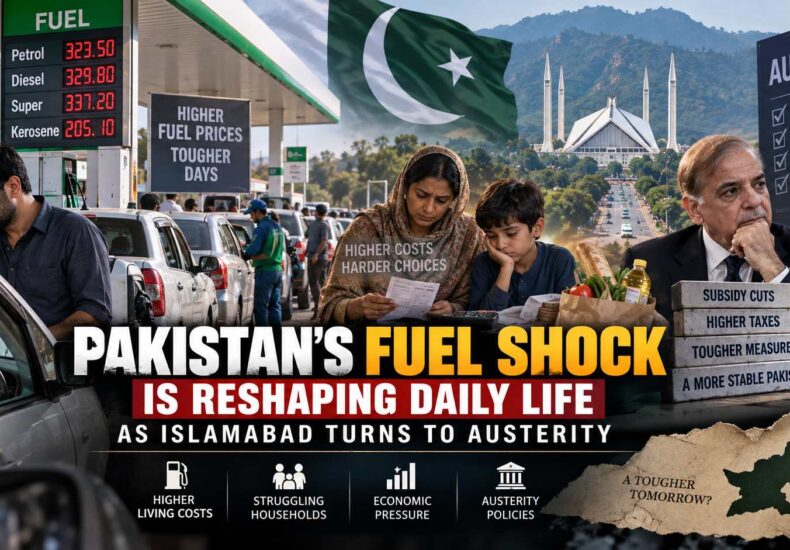
Pakistan’s Fuel Shock Is Reshaping Daily Life as Islamabad Turns to Austerity
Pakistan is once again asking its government, businesses and citizens to conserve fuel.
But this time, the story is bigger than a simple fuel-saving campaign.
As fighting and instability in the Middle East disrupt energy markets and raise the cost of imported oil and gas, Islamabad has revived a sweeping austerity program. Government vehicles will receive less fuel, official foreign travel is being restricted, new government vehicle purchases have been halted, and even official dinners face limits.
At the same time, shops and markets are being told to close earlier, restaurants must shut by 11 p.m., and weddings are subject to a one-dish rule.
The measures are scheduled to remain in force for three months.
The unusual combination of government spending cuts and restrictions on everyday activity tells a larger story: Pakistan’s energy problem is increasingly becoming a problem of how the country operates.
Why Pakistan Is Turning to Austerity Again
Pakistan imports a large share of the energy it consumes, making the country vulnerable when international oil and gas prices rise sharply.
The current pressure is linked to the continuing Middle East conflict and disruptions around major shipping routes, including the Strait of Hormuz and the Red Sea. Attacks on energy infrastructure have added another layer of uncertainty to an already volatile market.
For Pakistan, higher global energy prices create several problems at once.
Imported fuel becomes more expensive. Transportation costs rise. Electricity and industrial production can become more costly. Households face higher prices, while the government faces pressure to cushion consumers from the full increase.
It is a bit like trying to balance a household budget after the price of gasoline, electricity and groceries all rise at the same time.
The government has limited room to absorb every increase.
Official Vehicles Are First in Line for Fuel Cuts
One of the clearest measures is aimed directly at the government itself.
Pakistan has ordered a 50 percent reduction in fuel allocations for official vehicles for three months. Operational vehicles used by the armed forces, law-enforcement agencies, essential services and certain other departments are exempt, while administrative and non-operational vehicles are subject to the reduction.
The government has also imposed a complete ban on purchasing vehicles, along with restrictions on buying durable goods, with an exception for IT-related procurement.
That sends a deliberate message: before asking the country to conserve, the state is attempting to reduce its own consumption.
Foreign Trips Are Being Put on Hold
Pakistan is also tightening the rules around government travel.
Federal officials have been prohibited from undertaking foreign visits for three months, with limited exceptions involving scholarships, training and certain institutional programs.
Where international travel is unavoidable, senior officials and other government representatives are required to travel economy class.
Officials have also been encouraged to replace physical meetings with teleconferencing whenever possible.
This may sound like a relatively small saving compared with the country’s overall fuel bill.
But austerity policies often work on two levels.
There is the direct financial saving, and then there is the political message that government officials are expected to share some of the restrictions being imposed on the wider population.
Pakistan Is Cutting More Than Fuel
The austerity program goes beyond petrol and diesel.
The government has ordered a 5 percent reduction in non-employee-related spending for the 2026-27 fiscal year. Government-funded seminars, conferences and training programs are also being restricted, while official dinners have been prohibited except for events involving visiting foreign delegations.
These steps show that Islamabad is treating the energy shock as a broader budget problem.
When imported fuel becomes more expensive, the government cannot simply look at the price at the petrol station. It must also consider transportation, electricity, public services and the cost of keeping government departments running.
Markets Will Close Earlier
The most visible changes, however, may be felt outside government offices.
Shops, markets, shopping malls, bazaars and grocery stores have been ordered to close by 9 p.m.
Marriage halls and similar venues must close by 10 p.m., while restaurants, cafes and other food outlets can operate until 11 p.m. Takeaway and home-delivery services are exempt from the restaurant closing restriction.
Essential services, including hospitals, pharmacies, medical facilities, fuel stations, CNG stations, electric-vehicle charging stations and certain IT businesses, are exempt.
The purpose is straightforward: fewer operating hours can mean less electricity and fuel consumption.
But there is another side.
For retailers, restaurant workers, delivery businesses and consumers, shorter operating hours can also mean fewer working hours and changes in shopping habits.
Even Weddings Are Part of the Energy Strategy
Perhaps the most striking measure is the restriction on wedding meals.
The government has ordered that only one dish be served at marriage-related functions and events.
On paper, this is about reducing consumption.
In practice, it also demonstrates how deeply the austerity campaign reaches into social life.
Pakistan has previously used similar conservation measures during periods of economic and energy stress. The latest restrictions therefore represent a return to a policy approach the government has already tested earlier in 2026.
The Government Is Fighting Two Problems at Once
It would be too simple to describe the latest measures as proof that Pakistan’s economy is collapsing.
The immediate trigger is an external energy shock.
At the same time, Pakistan’s underlying economic constraints make that shock harder to absorb.
The country has to pay for imported energy while trying to protect households and businesses from sudden price increases. It has also introduced a fuel-relief scheme for eligible motorcycles, rickshaws and small vehicles, illustrating the difficult balance between conserving fuel and protecting lower-income consumers.
That creates a policy dilemma.
Subsidize fuel heavily and government finances come under pressure.
Allow the full international price increase to reach consumers and households face a bigger cost-of-living shock.
Restrict consumption and economic activity may suffer.
There is no painless option.
Pakistan Has Seen This Movie Before
The latest announcement is not happening in isolation.
In March, Pakistan introduced another major fuel-saving campaign as oil prices surged during the earlier phase of the Middle East conflict. Measures included reductions in government fuel use, changes to office operations and temporary school closures.
Those earlier steps were subsequently extended as energy costs remained elevated.
The return of austerity measures several months later suggests that Islamabad is dealing with a continuing vulnerability rather than a one-time price spike.
Every new disruption in global energy markets can quickly become a domestic policy problem.
The Bigger Risk Is the Energy Supply Chain
Pakistan’s challenge is not only the price of crude oil.
The country also needs reliable supplies of natural gas and liquefied natural gas.
Reuters reported that disruptions around major Middle Eastern shipping routes have pushed Asian LNG prices sharply higher, while Pakistan is preparing for potential gas shortages during the winter.
That could create pressure far beyond petrol stations.
Gas shortages can affect electricity generation, factories, transport and households.
So the government’s early-closing rules and official fuel cuts are best understood as part of a wider attempt to reduce demand before shortages become more severe.
The Question Is Whether Austerity Can Buy Enough Time
Pakistan’s government can reduce official vehicle use.
It can postpone international trips.
It can close markets earlier and limit government spending.
But none of these measures can determine the global price of oil or reopen an international shipping route.
That is the central weakness of the strategy.
Austerity can reduce consumption, but it cannot eliminate Pakistan’s dependence on imported energy.
The country therefore faces a longer-term question: how can it become less exposed to the next global energy shock?
From Fuel Crisis to Economic Test
Pakistan’s latest austerity push is more than a list of restrictions.
It is a snapshot of how an international conflict can travel thousands of miles through oil tankers, LNG cargoes and financial markets before eventually reaching a government office, a petrol station, a shop and a family wedding.
The immediate objective is to conserve fuel and reduce spending while global energy markets remain under pressure.
But the deeper test is whether Pakistan can absorb another external shock without allowing energy costs to trigger a much wider economic slowdown.
For now, Islamabad is choosing conservation.
The real question is how long the country will have to keep doing it—and whether the next solution will come from cutting consumption or from reducing its vulnerability to imported energy in the first place.
You may also like
Leave a Reply