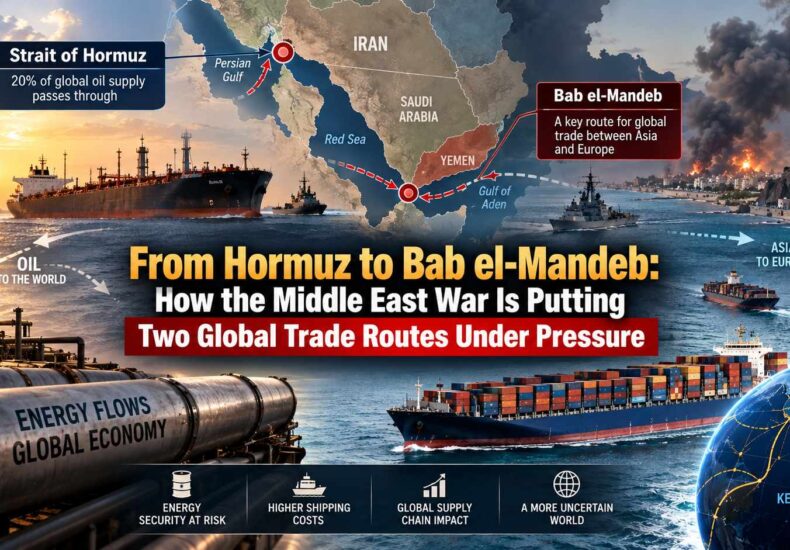
From Hormuz to Bab el-Mandeb: How the Middle East War Is Putting Two Global Trade Routes Under Pressure
For much of the current Middle East conflict, the Strait of Hormuz has been the central concern for global energy markets.
Now another narrow stretch of water is attracting attention.
Thousands of kilometers away, Yemen’s Iran-aligned Houthi movement has rapidly expanded its position along the Red Sea coast and around the Bab el-Mandeb Strait, creating a second pressure point for ships carrying oil, fuel and other goods between Asia, the Middle East and Europe.
The significance is difficult to overstate.
Hormuz sits between Iran and Oman and connects the Persian Gulf with the Gulf of Oman. Bab el-Mandeb connects the Red Sea with the Gulf of Aden and ultimately the wider Indian Ocean.
Put the two together and the geography starts to look less like two separate crises and more like a chain.
If one route becomes dangerous, ships can sometimes find alternatives. But when pressure builds at both ends of the Middle East’s major maritime network, those alternatives become more expensive, slower and harder to organize.
The Second Chokepoint Is Bab el-Mandeb
Bab el-Mandeb is only around 19 kilometers wide at its narrowest point, making it one of the world’s important maritime chokepoints.
Its importance goes far beyond Yemen.
Ships using the waterway can enter the Red Sea and continue toward the Suez Canal, creating a major connection between Asian and European markets.
That is why the Houthis’ recent territorial gains are attracting attention far beyond Yemen itself.
Reuters reports that the group captured the port city of Mocha and several islands near the mouth of the strait, giving its forces positions along much of Yemen’s Red Sea coastline.
The development does not automatically mean commercial shipping has stopped.
It does mean that the Houthis have gained geography that can make threats against shipping more credible.
Why Saudi Arabia Is Especially Exposed
There is an important twist to this story.
The Red Sea has become more valuable precisely because the Strait of Hormuz has become more difficult to use.
Saudi Arabia has infrastructure that allows some oil to bypass Hormuz by moving crude across the kingdom to the Red Sea port of Yanbu.
That creates an alternative route.
But if the Red Sea side of that alternative becomes vulnerable, the value of the workaround is reduced.
Reuters reported that the Houthi advance toward Bab el-Mandeb has exposed Saudi Arabia’s oil exports to a new risk at a time when the kingdom is already dealing with disruption around Hormuz.
In simple terms, Saudi Arabia may have built a second road around one traffic jam, only to discover that another threat is developing at the other end of the road.
The Numbers Explain Why Markets Care
Bab el-Mandeb is not just strategically important because of its location.
It carries significant volumes of energy and commercial traffic.
Reuters reported that crude oil and petroleum liquids moving through Bab el-Mandeb averaged about 8.1 million barrels per day during the second quarter of 2026, compared with 5.4 million barrels per day in the final quarter of 2025. Some of the increase was linked to Saudi Arabia redirecting crude toward the Red Sea to avoid Hormuz.
That creates an important paradox.
The more useful Bab el-Mandeb becomes as an alternative to Hormuz, the more strategically valuable it becomes to anyone capable of threatening it.
The two waterways therefore cannot be viewed independently.
The Houthis Do Not Need to Stop Every Ship
One of the biggest misconceptions about maritime disruption is that an armed group must completely close a waterway to cause economic damage.
It does not.
A handful of attacks, threats or uncertainty can be enough to make shipping companies reconsider a route.
A vessel operator has to think about insurance, crew safety, naval escorts, delays, fuel costs and the possibility that a vessel could become a target.
That calculation can change even when the majority of ships continue sailing.
The result can be a form of economic pressure without a formal blockade.
The Houthis have already demonstrated their ability to use missiles and drones against maritime targets, while their recent territorial expansion gives them additional positions from which to threaten the Red Sea.
But “Iran Controls Both Chokepoints” Is Too Simple
The growing connection between Hormuz and Bab el-Mandeb does not mean Iran directly commands both waterways.
That distinction matters.
The Houthis are closely aligned with Iran and have received Iranian support, but they are a separate movement with their own interests and decision-making.
The Institute for the Study of War notes that the Houthis receive extensive Iranian support but are not simply under Iranian command and have pursued objectives that do not always mirror Tehran’s immediate preferences.
That makes the situation more complicated than a straightforward chain of command.
Iran can gain strategically from Houthi pressure without necessarily controlling every Houthi decision.
China Has Suddenly Entered the Picture
The widening maritime threat is also producing an unusual diplomatic development.
Reuters reported that Saudi Arabia appealed to China for help, after which Beijing privately asked Tehran to help restrain the Houthis, according to Iranian sources familiar with the matter.
China has major economic interests in stable trade routes between Asia, the Middle East and Europe.
That gives Beijing a reason to become involved diplomatically even if it does not want to become a military participant in the conflict.
The development also shows how a crisis that began around regional security and Iran’s confrontation with the United States is increasingly creating problems for countries far beyond the immediate battlefield.
The Suez Canal Is Part of the Equation
Bab el-Mandeb matters because it is the southern entrance to the Red Sea.
From there, ships can travel north toward the Suez Canal.
If the route becomes too dangerous, vessels traveling between Asia and Europe can instead take the much longer journey around Africa’s Cape of Good Hope.
That alternative works.
But it costs time and money.
Ships consume more fuel, voyages take longer and fewer vessels can complete the same number of trips in a given period.
Those costs eventually filter through global supply chains.
A container arriving late in Europe may mean higher transport costs for manufacturers. Higher shipping insurance can raise the price of imported goods. Longer voyages can tighten available shipping capacity.
A narrow waterway can therefore have consequences thousands of kilometers away.
Oil Is Only Part of the Story
It is tempting to view the issue entirely through the price of crude oil.
But the implications are broader.
The Red Sea is an important commercial corridor connecting Asian and European markets. Any sustained disruption can affect container shipping, energy products, food shipments and manufactured goods.
And because the conflict is occurring alongside pressure around Hormuz, the world’s shipping industry is dealing with several risks simultaneously.
That is what makes the current situation different from an isolated attack on one shipping lane.
Saudi Arabia Faces a Difficult Strategic Calculation
Riyadh now has to balance several competing priorities.
It needs to protect its territory and energy infrastructure. It needs to keep export routes functioning. It must decide how much military pressure to apply against the Houthis while avoiding a wider regional escalation.
And there is another consideration: the United States.
Reuters reported that the Houthi advance has exposed questions about the limits of U.S. protection for Saudi Arabia as Washington remains focused on the wider conflict with Iran.
That does not mean the United States has abandoned Saudi Arabia.
Rather, it highlights the difficulty of protecting multiple strategic locations at once.
The U.S. Faces a Different Problem
For Washington, Bab el-Mandeb creates another strategic dilemma.
The United States wants shipping lanes to remain open, but expanding military operations against the Houthis could create another front in an already complicated regional war.
Reuters has reported that U.S. officials recently held talks with Houthi representatives in Oman. The talks illustrate the diplomatic effort to prevent the conflict from expanding further while maintaining pressure on threats to shipping.
The challenge is finding a way to protect maritime commerce without turning every shipping attack into a new military escalation.
Two Chokepoints Could Create One Global Problem
This is ultimately why the developments around Bab el-Mandeb deserve attention.
Hormuz and Bab el-Mandeb are not next to each other. They are controlled by different actors and present different military challenges.
But they serve connected economic networks.
One sits at the entrance to the Persian Gulf.
The other sits at the gateway to the Red Sea.
Pressure on both simultaneously reduces the number of practical alternatives available to global shipping.
That is a very different problem from dealing with one threatened waterway.
The New Battle Is Over Routes, Not Just Territory
The most important shift may therefore be geographical.
Modern conflicts are increasingly fought not only over cities, borders and military bases, but also over the routes connecting economies.
A port can become a weapon.
An island can become a surveillance post.
A narrow strait can become bargaining power.
And a shipping threat can influence prices without a single commercial vessel being permanently prevented from sailing.
The Houthis’ recent expansion around Bab el-Mandeb demonstrates how quickly a local military advance can acquire global significance.
For Saudi Arabia, it creates a new security challenge.
For Iran, it adds another source of leverage.
For China and other trading nations, it creates a diplomatic problem.
For shipping companies, it means another risk to calculate.
And for consumers around the world, the consequences may eventually appear in places that seem completely disconnected from Yemen—a fuel station, a supermarket or the price of a product arriving from Asia.
The real significance of Bab el-Mandeb is therefore not that it has become another Hormuz.
It is that the world may now have to manage two connected maritime pressure points at the same time.
You may also like
Leave a Reply