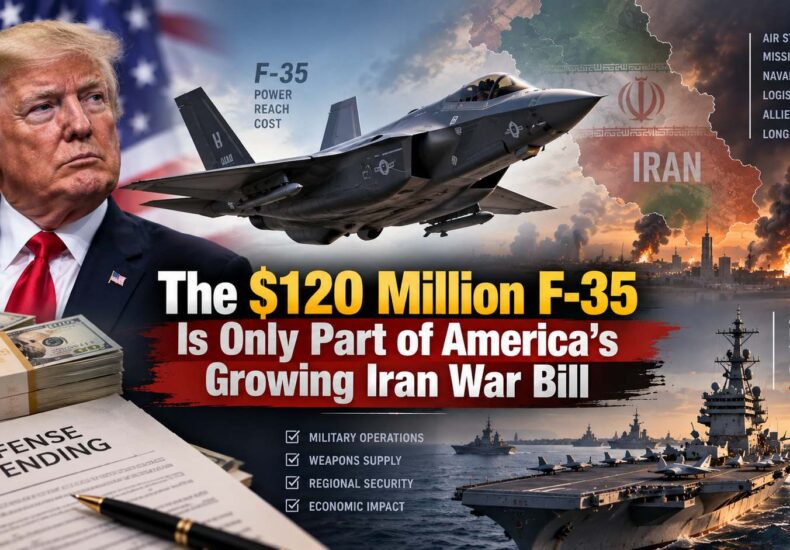
The $120 Million F-35 Is Only Part of America’s Growing Iran War Bill
A damaged U.S. F-35A fighter has become one of the most striking numbers emerging from the latest accounting of America’s war with Iran.
The aircraft is associated with an estimated $120 million repair-or-replacement cost.
That figure sounds enormous on its own. But it becomes much more significant when placed alongside the Congressional Budget Office’s estimate that the U.S. Department of Defense had spent roughly $38 billion on the conflict through August 1, 2026.
And even that $38 billion does not represent the full economic cost of the war.
The CBO says the figure covers direct Defense Department expenses, including expended munitions, equipment lost in battle, additional flying hours, fuel and other operational costs. If the fighting continues, the Pentagon’s bill could rise by another $2 billion to $3 billion per month, depending on the intensity of combat.
That changes the story.
The F-35 may be the headline-grabbing number, but the bigger issue is how expensive it is to keep a modern military operating through a prolonged high-intensity conflict.
The F-35 Number Needs Some Context
The EurAsian Times report highlights a $120 million figure associated with the damaged F-35A.
But calling it simply a “$120 million damaged jet” can create the wrong impression.
The available reporting does not establish that the United States has decided to scrap the aircraft and buy an entirely new F-35.
The aircraft is listed as damaged, and the reported $120 million figure is associated with repair or replacement. Whether the Air Force ultimately repairs the aircraft or replaces it depends on the damage assessment and military decisions.
That distinction matters.
A fighter aircraft can be damaged without becoming a total loss.
And even when an aircraft is eventually written off, its purchase price is only one part of the financial impact.
There are spare parts, maintenance, weapons, personnel, training, logistics and the loss of an aircraft that was supposed to remain available for future missions.
The $38 Billion Is Not the Whole War Bill
The CBO’s estimate is perhaps the most important number in the story.
As of August 1, the armed conflict had cost the Defense Department approximately $38 billion.
The money covers several categories, including replacing expended weapons, replacing equipment lost in battle, increased flight operations and fuel costs.
But the number should not be described as the total cost of the Iran war.
It does not capture every economic consequence.
For example, higher energy prices affect households and businesses. Shipping disruptions raise transportation costs. Other federal agencies can also face additional expenses.
The CBO separately warned that the conflict’s disruption of oil and natural-gas shipments through the Strait of Hormuz and shipping through the Red Sea has already created broader inflationary pressure.
So there are really two bills.
There is the Pentagon bill.
And there is the bill that spreads through the wider economy.
The Weapons Bill May Be More Important Than the Fighter
The most revealing part of the CBO assessment may not be the F-35 at all.
It is ammunition.
CBO estimated that replacing expended munitions accounts for the largest share of the direct military costs. Previous reporting on the assessment put the figure at roughly $21.7 billion, including about $13.1 billion for missile-defense interceptors.
Why does that matter?
Because a fighter jet is a highly visible asset.
A missile interceptor fired during an attack is gone.
A cruise missile launched against a target is gone.
A Patriot or THAAD interceptor used to protect a base cannot simply be recovered and returned to storage.
And replacing sophisticated weapons can take much longer than replacing ordinary equipment.
The war is therefore consuming something that cannot be replenished instantly: the U.S. military’s stockpile of ready-to-use weapons.
America Is Running Into the Industrial Reality of Modern War
This is where the conflict becomes an industrial problem.
The United States can authorize billions of dollars for new weapons.
That does not mean factories can immediately produce them.
The Pentagon’s inspector general has reported strategic ammunition shortfalls and bottlenecks in the industrial base following the expenditure of weapons during Operation Epic Fury. The earlier Pentagon review estimated that the operation cost about $33.4 billion between February 28 and June 30, with approximately $22.3 billion going toward munitions.
The CBO has also warned that rebuilding some depleted inventories could take years.
One estimate suggests that restoring certain missile-defense stocks could take at least five years even if production rates increase.
That is a very different problem from simply finding money in the federal budget.
It is a manufacturing problem.
The F-35 Is Already Expensive to Keep Flying
The F-35’s $120 million figure also needs to be viewed against the aircraft’s broader financial burden.
The Government Accountability Office has described the F-35 as the Defense Department’s most expensive weapon system.
As of 2024, the U.S. fleet’s estimated lifetime sustainment cost was about $1.6 trillion. The GAO also found that the fleet’s mission-capable rate declined from 67% in fiscal year 2021 to 44% in fiscal year 2025.
That does not mean the F-35 is uniquely responsible for the costs of the Iran war.
Rather, it shows why losing or damaging an advanced aircraft is only the beginning of the accounting.
Modern military power depends on keeping complex aircraft supplied with parts, maintenance and trained personnel.
A $120 million aircraft is effectively a small piece of a much larger financial ecosystem.
Air Power Does Not Eliminate Vulnerability
The conflict also demonstrates an uncomfortable reality for technologically advanced militaries.
A country can possess sophisticated stealth aircraft, long-range missiles and advanced air defenses while still suffering expensive losses.
The F-35 is designed to reduce the risk of detection and improve survivability.
But no aircraft is invulnerable.
And the battlefield is not limited to the sky.
Aircraft can be damaged or destroyed while operating from bases. Air-defense systems can be attacked. Fuel supplies can be disrupted. Communications infrastructure can come under pressure.
That means military planners have to protect not just aircraft, but the entire network supporting them.
The Cost Continues Even When the Shooting Slows
One of the most important points in the CBO report is that the financial meter does not stop when combat intensity falls.
The agency estimates that another month of fighting could cost roughly $2 billion if violence remains around the lower levels seen in May and June.
If combat returns to the intensity experienced in July, monthly costs could reach about $3 billion.
And the CBO warns that costs could be higher if fighting becomes even more intense.
There is another reason the bill continues after individual battles.
Weapons have to be replaced.
Aircraft have to be repaired.
Damaged bases need reconstruction.
Maintenance schedules have to be restored.
Training pipelines need to be replenished.
The war therefore creates a financial tail that can continue long after individual strikes have ended.
The Economic Cost Is Moving Beyond the Pentagon
The war’s financial consequences are also reaching consumers.
The CBO says disruptions to oil and natural-gas shipments through the Strait of Hormuz and shipping through the Red Sea have pushed energy prices higher.
Those increases can eventually spread into the prices of other goods because petroleum is used throughout transportation and supply chains.
The CBO estimated that overall personal consumption expenditures inflation in the second quarter of 2026 was significantly affected by higher energy prices and projected that inflation in the first quarter of 2027 would be about 0.5 percentage points higher than it had previously forecast because of the conflict.
That creates a feedback loop.
War increases energy prices.
Higher energy prices increase transportation and production costs.
Higher costs push inflation upward.
And inflation can complicate monetary and fiscal policy.
The Real Question Is Not Whether America Can Afford One F-35
The United States can obviously afford to replace individual aircraft.
The more difficult question is whether the country can sustain a prolonged conflict while simultaneously maintaining readiness for other possible threats.
That is where stockpiles become important.
If thousands of expensive interceptors and precision weapons are used during one conflict, those weapons are no longer available for another crisis until they are replaced.
The issue is therefore not bankruptcy.
It is strategic availability.
A military can have enormous resources on paper and still face difficult choices if its most sophisticated weapons cannot be replenished quickly enough.
What the $120 Million Figure Really Tells Us
The damaged F-35 has become a symbol of the cost of modern warfare.
But the aircraft itself is not the central financial story.
The bigger story is everything surrounding it.
Every flight requires fuel.
Every combat mission consumes weapons and maintenance hours.
Every damaged aircraft requires repair or replacement.
Every missile-defense interceptor used in combat has to be rebuilt in a factory.
And every additional month of war adds another layer of expenses.
The United States entered the conflict with one of the world’s largest and most sophisticated military-industrial systems.
The Iran war is now testing how quickly that system can replenish what modern combat consumes.
The $120 million F-35 figure is therefore less a story about the price of one fighter than a window into the economics of sustained warfare.
The $38 billion already spent is the larger warning.
And if the conflict continues, the question facing Washington will not simply be how much another fighter costs.
It will be how much the country must spend to replace the weapons, aircraft, equipment and readiness that a long war consumes—and how quickly American industry can build them back.
You may also like


Leave a Reply