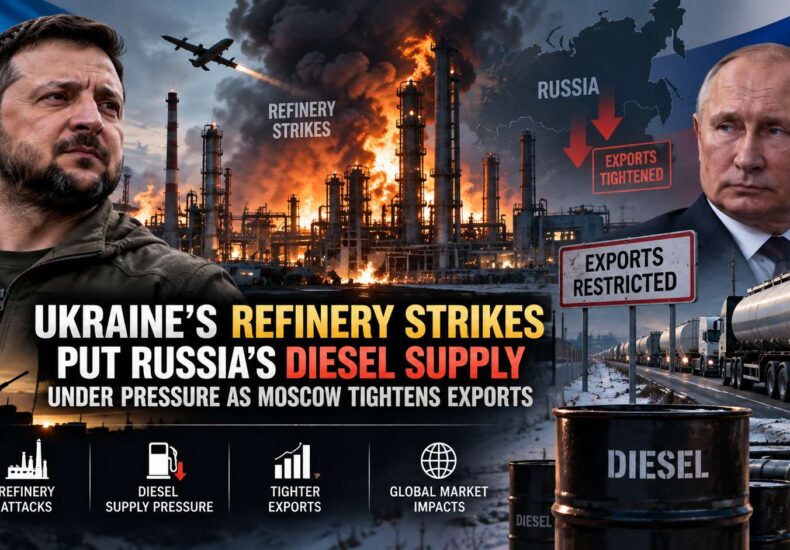
Ukraine’s Refinery Strikes Put Russia’s Diesel Supply Under Pressure as Moscow Tightens Exports
Russia’s fuel problem is becoming harder to contain.
A Ukrainian drone attack has damaged a major Russian refinery in the Yaroslavl region, adding to a growing list of energy facilities disrupted by strikes. At almost the same time, Moscow is preparing to extend restrictions on diesel exports as it tries to keep enough fuel inside the country.
The combination reveals a bigger problem than one damaged refinery.
Russia is increasingly being forced to choose between protecting its domestic fuel market and maintaining its role as one of the world’s major suppliers of refined petroleum products.
The latest attack hit the Yaroslavl refinery, also known as YANOS, roughly 250 kilometers northeast of Moscow. Reuters reported that the facility halted crude processing after drones damaged its main AVT-3 crude-distillation unit. Another major processing unit was already undergoing repairs following an earlier drone attack.
That means the latest strike arrives at a particularly difficult moment for Russia’s refining industry.
A Major Refinery Has Lost More Processing Capacity
The Yaroslavl refinery is not a small regional facility.
Reuters estimates that it can process around 300,000 barrels of crude oil per day, equivalent to about 15 million metric tons annually. In 2024, it processed 14.9 million tons of crude and produced roughly 4 million tons of diesel, along with gasoline and fuel oil.
The latest strike damaged the AVT-3 unit, which normally processes about 17,140 metric tons of crude per day, or roughly 40% of the refinery’s total capacity.
The problem becomes more serious because another unit, AVT-4, was already offline for repairs after being damaged in an August 28 drone strike.
In other words, the latest attack did not hit a refinery operating at full strength.
It hit a facility that was already dealing with previous damage.
Ukraine Is Targeting the Weak Point in Russia’s Fuel System
Ukraine has increasingly used long-range drones to strike Russian oil refineries and other energy infrastructure.
Kyiv has argued that these attacks are intended to increase the economic cost of Russia’s war by disrupting the country’s ability to process crude and supply fuel.
Moscow, meanwhile, has condemned the attacks and has faced growing pressure to maintain adequate domestic fuel supplies.
The result is a strange equation.
Russia still has enormous crude production capacity, but producing crude is only part of the process.
Oil has to be refined into products such as diesel and gasoline.
If refineries are damaged, having crude oil underground does not immediately solve the shortage at a fuel station.
Russia’s Refining Industry Is Under Unusual Pressure
The International Energy Agency says Russia has around 32 major refineries with approximately 6.5 million barrels per day of installed refining capacity.
But actual processing has fallen substantially.
According to the IEA, Russian refinery throughput dropped to about 3.8 million barrels per day in June 2026, the lowest level in more than two decades and roughly 30% below the previous year’s level. The agency estimated gasoline production was down about 20% year-on-year, while diesel production had fallen by nearly 30%.
Those numbers help explain why Moscow has been restricting exports.
The issue is not simply that Russia wants to sell less fuel abroad.
It needs to keep enough fuel at home.
Why Moscow Keeps Extending the Diesel Ban
Russia initially introduced its latest diesel export restrictions as part of an effort to stabilize the domestic fuel market.
The current producer export ban has already been extended through September 30. The IEA says reports indicate that the restriction is likely to be extended through October as continued refinery disruptions put pressure on supplies.
That distinction matters.
An October extension should not be presented as a fully completed policy unless Moscow formally announces it.
But the direction is clear: Russia is prioritizing domestic availability over maintaining unrestricted diesel exports.
The Kremlin has also backed the idea that restrictions on exports can help stabilize supplies inside Russia.
The Timing Could Hardly Be More Difficult
Russia’s diesel demand is not constant throughout the year.
Agriculture, transport, construction and industrial activity can all increase fuel consumption.
The IEA has highlighted the additional pressure created by the 2026 harvest season, when agricultural demand for diesel typically rises.
This creates a timing problem for Moscow.
Just as domestic demand needs to remain well supplied, refinery capacity is being reduced by attacks, maintenance and other disruptions.
It is like trying to fill a bathtub while several drains are opening at the same time.
More crude can be supplied to refineries, but damaged processing units cannot simply be replaced overnight.
Russia Has Already Experienced Fuel Shortages
The consequences have moved beyond government statistics.
The IEA reported that fuel shortages affected a large share of Russia’s regions during the summer. By the end of June, shortages had reportedly been recorded in 92% of Russian regions, while around two-thirds had introduced some form of fuel rationing, including purchasing limits and QR-code systems.
Some motorists reported waiting as long as 40 hours at fuel stations.
Although the situation improved somewhat later in the summer, another wave of refinery attacks contributed to renewed pressure.
Fuel prices have also risen.
Russia’s statistics agency Rosstat reported that gasoline prices had increased by more than 19% since the beginning of 2026 by late August, while diesel prices had risen roughly 18%.
That turns refinery damage into a much broader economic problem.
The Export Ban Has Global Consequences Too
Russia is one of the world’s major refined-fuel exporters.
So when Moscow keeps diesel at home, international buyers have to look elsewhere.
That does not necessarily mean the world suddenly runs out of diesel.
Oil products can move between regions, and other producers can increase exports when economics allow.
But the supply chain becomes tighter.
Reuters reported that Russian seaborne oil-product exports increased 16.4% month-on-month in August to 4.57 million metric tons as some refineries returned from unplanned maintenance.
Yet exports of fuel, particularly naphtha and fuel oil, were still about 50% below the level of August 2025, reflecting the impact of Ukrainian attacks and the diesel export restrictions.
That contrast is revealing.
Russia can temporarily increase exports when damaged refineries return to service, but the underlying system remains under pressure.
The World’s Diesel Market Is Already Tight
The Russian disruption is happening against a much larger global backdrop.
Reuters reported that combined net diesel exports from Russia and the Gulf had fallen by 1.6 million barrels per day between February and August. Before the current conflicts intensified, those regions accounted for almost 45% of global seaborne diesel trade.
That is why refinery attacks matter beyond Russia and Ukraine.
Diesel powers trucks, agricultural machinery, ships, trains, construction equipment and industrial machinery.
It is not merely another petroleum product.
It is part of the infrastructure of the global economy.
When diesel becomes scarce or expensive, transportation costs can rise, affecting everything from food deliveries to industrial production.
Russia Is Also Importing Fuel
An unusual consequence of the refinery disruption is that Russia itself has had to increase some fuel imports.
Reuters has reported that Russian gasoline imports surged as domestic refinery problems worsened.
This creates an extraordinary reversal for one of the world’s largest energy exporters.
Russia can remain a major crude producer while simultaneously experiencing shortages of refined products.
That distinction is essential to understanding the current crisis.
The country is not necessarily running out of oil.
It is struggling to turn enough of that oil into the fuels its domestic economy needs.
The Bigger Battle Is Now Inside the Refining System
Ukraine’s strategy appears increasingly focused on processing capacity rather than simply crude production.
That matters because refineries are complicated, expensive and highly interconnected facilities.
Damaging one key unit can reduce the output of an entire plant.
And when several refineries experience problems at the same time, maintenance becomes more difficult because spare parts, engineering teams and alternative processing capacity may all be stretched.
The Yaroslavl attack illustrates this vulnerability.
One unit was damaged while another was already under repair.
That creates a compounding effect.
Moscow Faces a Difficult Choice
Russia now has several options, but none is cost-free.
It can restrict exports further, preserving fuel for domestic consumers but reducing revenue and supplies available to international buyers.
It can increase imports, although that means buying products that Russia normally exports.
It can accelerate refinery repairs, but major industrial equipment cannot always be restored quickly.
Or it can increase pressure on Ukraine to stop attacks on energy infrastructure.
The Kremlin has welcomed calls from U.S. President Donald Trump for Ukraine to halt attacks on Russian diesel facilities. Trump has argued that the strikes are contributing to fuel shortages affecting the wider market.
But whether such calls produce a sustained halt in attacks remains uncertain.
The Real Warning for the Oil Market
The Yaroslavl strike is important not because one refinery has stopped operating.
It is important because it shows how repeated attacks can gradually change the economics of an entire fuel system.
Russia has enormous crude resources.
But crude reserves do not guarantee diesel availability.
A refinery can be damaged in minutes, while restoring sophisticated processing equipment can take weeks or months.
And every time another facility goes offline, Moscow has fewer options for keeping domestic fuel supplies comfortable while continuing to export petroleum products.
That is why the diesel export ban may be more than a temporary administrative measure.
It is increasingly becoming evidence of a deeper balancing act.
Russia is being forced to defend its fuel supply chain from the inside while Ukraine is trying to disrupt it from the outside.
The outcome could extend well beyond the battlefield.
If Russian refining capacity remains constrained and Moscow continues to keep diesel at home, international buyers will compete for replacement supplies at a time when other energy disruptions are already squeezing the global market.
The biggest question is therefore no longer simply whether Ukraine can damage another Russian refinery.
It is whether Russia can keep its vast oil industry functioning as a reliable fuel supplier when the infrastructure between the oil well and the fuel pump is repeatedly coming under attack.
You may also like



Leave a Reply