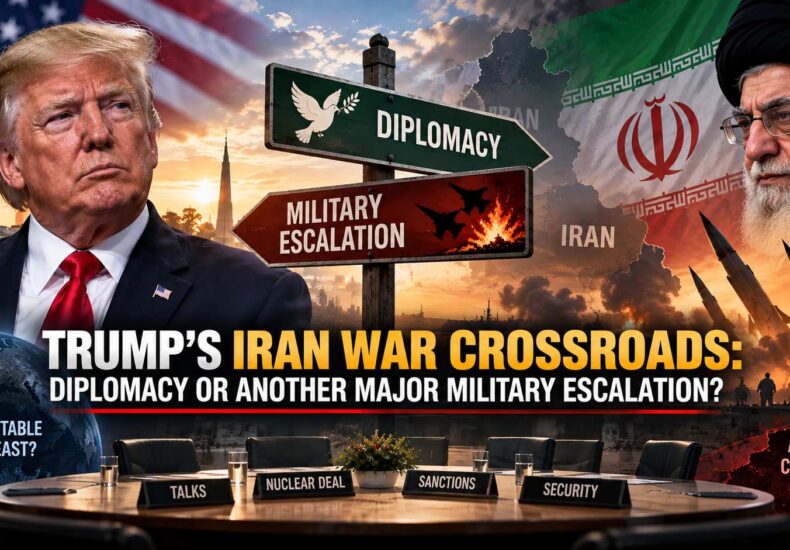
Trump’s Iran War Crossroads: Diplomacy or Another Major Military Escalation?
The Iran war may be approaching one of its most consequential moments, but the next move from Washington is still unclear.
President Donald Trump says he is facing a “big decision” over whether to launch another major military campaign against Iran. At the same time, he has said he hopes the conflict is nearing its end and that Tehran wants a deal.
That combination has created an unusual moment in the nearly seven-month war: Washington is talking about an exit while keeping the door open to a much larger military escalation.
Trump’s comments came as the conflict continued to put pressure on shipping, energy markets and U.S. relationships across the Gulf. The situation has also become more complicated with Iran-aligned Houthi forces increasing pressure around the Red Sea and Saudi Arabia facing attacks linked to the wider conflict.
The question now is not simply whether Trump will attack again.
It is whether he believes another major military push would bring the war closer to an acceptable settlement—or make an already complicated regional conflict even harder to end.
Trump Says a Major Decision Is Near
In an interview with Axios, Trump said he was approaching a critical juncture and was considering whether to resume large-scale attacks against Iran.
He described the choice as a major one and said that “anything could happen.” The comments indicate that military escalation remains an option, rather than confirming that a new attack has been ordered.
That distinction matters.
There is currently no confirmed announcement that Washington has decided to restart a major bombing campaign.
Instead, Trump is publicly signaling that he is weighing his options.
For Iran, Gulf governments and markets, that uncertainty can be significant in itself.
Only a Day Earlier, Trump Was Talking About the War Ending
The timing of Trump’s latest remarks is striking.
Just one day earlier, he said he hoped the war was approaching its end.
Trump also said Iran wanted to make a deal, although he indicated that Tehran was not yet ready for an agreement acceptable to Washington.
Those statements do not necessarily contradict each other.
A president can believe negotiations might end a conflict while simultaneously preparing for renewed military pressure if negotiations fail.
But they reveal how uncertain the next phase of the war remains.
The conflict has reached a point where diplomacy and military pressure are operating side by side.
The Gulf States Could Influence the Next Move
Trump is expected to meet leaders or senior officials from the six Gulf Cooperation Council countries on the sidelines of the United Nations General Assembly in New York next week.
The group includes Saudi Arabia, the United Arab Emirates, Qatar, Bahrain, Kuwait and Oman.
The discussions are expected to address the conflict and Washington’s plans for the region after the fighting.
That meeting could be important because Gulf states are not simply observers of the war.
They have faced missile and drone threats, disruptions to energy infrastructure and growing concerns about shipping routes.
At the same time, they have strong reasons to avoid becoming the battlefield for a wider confrontation between Washington and Tehran.
Saudi Arabia Is Already Facing a New Security Problem
The conflict has also expanded beyond the immediate U.S.-Iran confrontation.
Iran-aligned Houthi forces in Yemen have increased their military activity and gained strategically important positions around the Red Sea.
Reuters has reported that the Houthi advance has created additional pressure on Saudi Arabia and complicated the security situation around another major maritime chokepoint.
That matters because Saudi Arabia is simultaneously dealing with the consequences of disruption around the Strait of Hormuz.
If pressure develops around both Hormuz and the Bab el-Mandeb area, the consequences can extend well beyond the battlefield.
Oil shipments, shipping insurance and international trade can all be affected.
The Strait of Hormuz Remains a Central Issue
Hormuz is one of the world’s most important energy corridors.
A prolonged disruption there puts pressure on global oil markets because large volumes of crude and other energy products normally pass through the waterway.
Recent reporting has described continuing restrictions and uncertainty around shipping through the strait, while oil prices have remained sensitive to developments in the conflict.
For the Trump administration, this creates a difficult calculation.
Military action could be intended to pressure Iran into reopening the route and accepting a broader settlement.
But additional strikes could also produce further retaliation and increase risks to shipping and energy infrastructure across the region.
That is the strategic dilemma behind the “big decision.”
Washington Is Also Under Financial Pressure
The war is no longer only a foreign-policy problem.
It has become a significant financial issue for the United States.
The Congressional Budget Office has estimated that the U.S. government’s direct military costs from the conflict had reached more than $38 billion through August 1, with additional monthly costs if operations continue.
That figure does not capture every economic consequence of the conflict.
Higher energy prices can affect transportation, manufacturing and household costs. Military operations also consume weapons and equipment that eventually have to be replaced.
For Washington, therefore, prolonging the war carries both strategic and economic consequences.
Congress Is Also Pushing for Greater Control
The political pressure inside the United States is growing.
On September 15, the House of Representatives passed another war-powers resolution aimed at limiting Trump’s ability to continue military operations without congressional authorization.
The measure passed 220-204, with seven Republicans joining Democrats. It has faced significant obstacles to becoming binding policy, however.
This adds another dimension to Trump’s decision.
The question is not only what military option the White House prefers.
It is also how much support that strategy can maintain in Congress as the conflict continues.
Tehran Is Sending a Different Message
Trump has said Iran wants a deal.
But Iranian officials have publicly presented a more complicated picture.
Iran has continued to demand conditions of its own and has rejected the idea that Washington can simply dictate the terms of a settlement.
Recent reporting also indicates that there has been no independently confirmed breakthrough establishing that formal new negotiations between Washington and Tehran have resumed.
That leaves a major gap between the public statements coming from Washington and Tehran.
Both sides may see diplomacy as useful.
Neither appears to have publicly accepted the other’s preferred terms.
The Nuclear Question Remains at the Center
One of Washington’s central objectives in the conflict has been limiting Iran’s nuclear capabilities.
Trump has repeatedly pointed to the need to prevent Iran from obtaining a nuclear weapon.
Iran, meanwhile, maintains that its nuclear program is peaceful.
Even after months of military action, the nuclear issue has not simply disappeared.
That means any lasting agreement would likely have to address more than a temporary ceasefire.
It would need to establish what happens to Iran’s nuclear activities, international monitoring, sanctions and the broader security arrangements surrounding the country.
Another Major Attack Would Carry Its Own Risks
Renewing large-scale attacks could increase pressure on Tehran.
But it could also trigger retaliation.
Iran has demonstrated the ability to target U.S. interests and regional partners, while allied groups have created additional security problems in Iraq, Yemen and around regional shipping routes.
That makes escalation difficult to isolate.
One strike can produce a response. That response can create another military decision.
The danger is a cycle in which every attempt to gain leverage produces another reason for the conflict to continue.
Diplomacy Now Has a Narrow Window
The most interesting feature of the current moment is that diplomacy has not disappeared.
Trump says a deal remains possible.
Iran has maintained its own demands.
Gulf countries are preparing to discuss the conflict with Washington.
China has also been involved diplomatically in efforts related to the wider regional crisis, including pressure on Iran concerning the Houthis.
But diplomacy is taking place while military forces remain active.
That makes the coming days particularly important.
A diplomatic channel can survive military pressure—but only if both sides believe negotiation offers a better outcome than continued fighting.
The Real Crossroads Is Bigger Than One Trump Decision
Trump’s “big decision” is being presented as a choice between another major military campaign and a different path.
But the reality is more complicated.
A decision to attack would not automatically end the war.
A decision to negotiate would not automatically produce a settlement.
And even a ceasefire with Iran would not necessarily resolve the wider regional problems involving Yemen, shipping routes, Gulf security and the nuclear issue.
The United States therefore faces a broader strategic question: how can it turn military pressure into a durable political outcome without creating another round of escalation?
That is the real crossroads.
For now, Trump has kept both options open.
He has signaled that diplomacy deserves a chance, while making clear that another major military operation remains under consideration if he decides negotiations are not producing the outcome Washington wants.
The next meeting with Gulf leaders, developments around Hormuz and the Red Sea, and any verified communication between Washington and Tehran could help determine which direction the conflict takes.
The war may be approaching a turning point—but a turning point is not the same thing as an ending.
You may also like
Leave a Reply